
EMS protocols change, mostly for the better. In 30 years as a paramedic, I have
Paramedics typically obtain venous access to administer medications and IV fluids by inserting an IV catheter into a peripheral vein (almost always in the upper extremities). For patients who lack venous access, if their condition merits, paramedics can obtain intraosseous access through an IO drill that goes through the bone into the marrow space, where medications administered through this method can make their way into the blood stream. In very rare cases of extremis, some paramedics (local protocol permitting) can access a central venous line in patients who already have them. This was not the case when I began as a paramedic. We also didn’t have IO drills, and to obtain IO access, we had to use a Jamshedi needle that was difficult to place and we normally only used them in pediatrics.
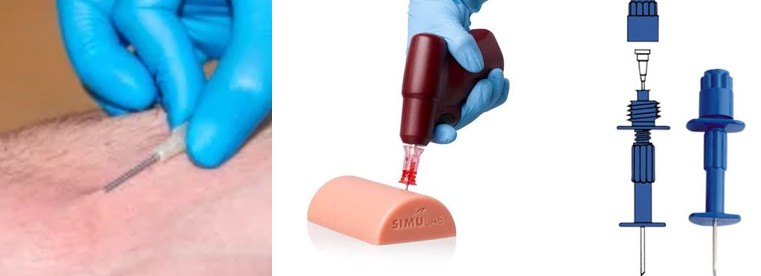
When I started, if we had a patient in cardiac arrest, if we could not get intravenous access, including access through the jugular vein in the neck, we could give meds down the Endotrachael tube — not the best or most reliable route. If you couldn’t get the ET tube and you couldn’t get the IV, there was no way to give the patient potentially life-saving medication. It happened to me a time or two in patients who had central catheters that we were not allowed to access. I know one medic who was suspended for a week because he said screw it and used the patient’s access. The reason we weren’t allowed was there is a higher risk for infection or a small risk for pulmonary embolism through this route. But these patients were in extremis — they were in cardiac arrest!
Several years ago, the Connecticut state paramedic protocols were amended to allow paramedics to access existing central lines for just this sort of scenario. (See Protocol 6.3A.)
Here is an example of a central line – a Hickman Dialysis Catheter
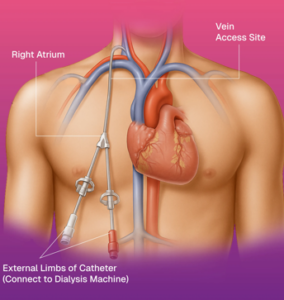
Here are the indications- For patients who already have a central line that may be
externally accessed.
- Immediate vascular access for cardiac arrest.
- Intravenous fluids or medications are urgently needed, peripheral intravenous
access cannot by established in a timely manner, AND the patient exhibits one
(1) or more of the following:
a. Hemodynamic instability (systolic BP <90).
b. Symptomatic tachycardia or bradycardia requiring urgent intervention.
c. Patient in extremis with immediate need for medication or intravenous
fluids (e.g., patient in status epilepticus, impending arrest, airway/
respiratory failure, dextrose in a patient refractory to IM glucagon, etc.).
Several months ago we were called for an unconscious patient at a dialysis center. When we arrived, the facility staff was running IV fluid in through the port of their Hickman catheter. They said he had been hypotensive and now his blood pressure was better, but he still wasn’t responding. I asked if he was diabetic. He was a double amputee. Ahh, yes, he is diabetic. Better check the sugar then. It turned out to be 31 — which explained why he was unconscious. I looked at his thick scarred arms and could see right away, he was going to be a difficult stick. I thought about the IO, but he had no legs. His neck was short and fat so a jugular vein would have been difficult, but not impossible. I could have also tried an IO in his shoulder, but as I saw the fluid still going into this port, I thought, wait a minute, we’re allowed to access these ports now and the staff is already using it for fluid administration. Why don’t I just spike a bag of D10 and run it in through the port, which I did (using proper sterile technique) and four minutes later, his eyes were open and he was admitting he had forgotten to eat before coming to dialysis.
I know not all paramedics have protocols allowing this, but it is a common sense solution and in the patient’s interest when the indications are present. I am grateful to those who sat in meetings and fought for this protocol change.