Skip to content


Archives for

See all posts in the network tagged with

Back In The City

5 comments

I have been rotated out of my suburban posting and am now back in the city. I had not worked a city shift in nearly three years since I took my second job as an EMS coordinator, and had not worked full time in the city in over a decade, although for many years I continued to work 20-40 hours a week of city overtime.

I forgot how much I loved it. I feel like I am back to my roots. There is a great vibrancy and mixture of life in the city and all its neighborhoods that fascinates me. True, there are some drawbacks — sitting in an ambulance on a street corner instead of feet up in a recliner watching TV — but now that I am the proud owner of a Kindle, I am once again reading voraciously. In just two days I read one of the best war novels I have ever read — Matterhorn — and am halfway through a fascinating book called Outliers: The Story of Success by Malcolm Gladwell about what really leads to success that I will post about soon.

My first day back in the city all but one of my patients were ambulatory, two met us at the street corner. The only patient who wasn’t walking on her own, of course, had to be carried on a backboard through the deep wet snow of a vacant field, after having been spotted laying prostate like a frozen snow angel. A touch of narcan in the ambulance to improve her respiratory drive, and some warm blankets and all was good.

And I cannot forget the city cusine. Years had passed since I had dined on cerdo asado (roast pork) con cerito (pork skin), yucca y tostones (fried green plantains). Good eating.

I still knew my way about the streets that I started on in 1995. The only nervousness I had was learning the new computer system, but after two days, I feel if I am not yet an expert, I am at least competent enough not to have to have my partner hold my hand while I write a PCR.

I do want to say that I had many wonderful years at my suburban posting, met many wonderful, compassionate people, who I will always consider my family. I wish all the volunteers there the best, and look forward to seeing them at the hospitals, and at training sessions.

***

Splinting

13 comments

I am today as excited about being a paramedic as I ever have been in my nearly twenty years with the rocker on my shoulder. This morning I came in and checked my gear and ambulance thoroughly. I paid particular attention to the splinting gear located under the bench seat. (There was a traction splint, an old rusted wire ladder splint and several cardboard splints of various sizes and shapes.) You see, what really has me excited is a chance today to splint a patient’s broken limb.

I have been in recent years a strong advocate for pain management. Treating and easing pain has become for me the reason to be in EMS. It is something I can do on the job every day. Cardiac arrests and major trauma — what many define as our landmark calls — are certainly not every day occurrences. Pain management is something we can do every day — something that really makes our patients feel better and thankful for our care.

Last week I had the opportunity to use Fentanyl for just the third time. We have only been carrying the drug for two weeks. I responded to an elderly male, who had fallen in his bathroom and broken his leg — likely his tibia and fibula. After a quick assessment I immediately gave him 50 mcg of Fentanyl IM into his right shoulder. (He was a dialysis patient and has very poor veins, so I made the decision to go right for the IM and get some relief to ease his 10 of 10 pain).

Within minutes, I could see a some relief crossing his face, although he reported the pain was still high — now an 8. Given where he lay, moving him to the stretcher was fairly difficult, but we put a pillow under his leg as we supported it and gently lifted him up. He did grimace, but felt slightly better once we had him supine. I elevated his leg, applied ice packs and padding, and then gave him another 50 mcg of Fentanyl while my partner shoveled the snow from the man’s patio so we could get the stretcher out without too much jostling. In the ambulance, I was able to get an IV — a 24 in the underside of the wrist — and give another 50 mcgs of Fentanyl IM. This last dose seemed to really do the trick. The ride into the hospital was largely pain free. He was down to a 4 on the pain scale, but then just as we arrived at the hospital, he said the pain was returning. Having already hit my standing order limit, I briefly considered calling for another dose. Fentanyl, while working quicker than morphine, does not last as long. But I punted, thinking having already given 150 mcgs to a 70-year-old man, they may not approve my request for another 50 seeing I was in their parking lot already. (I know I should have called anyway.)

At triage, I told the PA who examined the patients along with the nurse, that the patient had a likely broken leg, had gotten 150 mcgs of Fentanyl, which was wearing off and would likely need another dose. She agreed and placed the order. Placing the order however, still does not mean immediate relief. Once we got our room assignment, we took the patient down the hall and gently moved him over, and again, set his leg up on a pillow and some bath blankets. I could see in his grimace that the pain was getting much worse.

I went to the EMS room and wrote my report, and when I returned with it, I looked in the room to say good bye to the patient and it was then that it struck me. Here was my patient, laying in bed despite the 150 mcg of Fentanyl — the hospital ordered dose had yet to be dispensed — and he was still in considerable pain. I looked at his broken leg and it all came to in one big realization. Where was the splint? Sure there was a pillow and ice and some padding, but there was no splint. No secure immobilization to prevent the tiny bone ends from rubbing tissue should the patient try to reposition himself in bed.

Somehow over the years, my splinting had deteriorated from dutiful by the book EMT care to basically putting the broken bone on a pillow and trying to keep the patient still. Perhaps if I had done what as a new EMT so many years ago I had done, the patient would have been more comfortable. Now, I am not saying take away my morphine and Fentanyl and just give me a pile of splints and cravats, but I am saying I recognize a clear area for improvement.

In subsequent days I have sought advice from my peers and from MDs. I have read book chapters on splinting, Googled “splinting,” and just this morning, watched quite a good series on splinting on EHow: First Aid for Splints & Bleeding Wounds: Video Series

Here is one on How to Apply a Shoulder Sling.

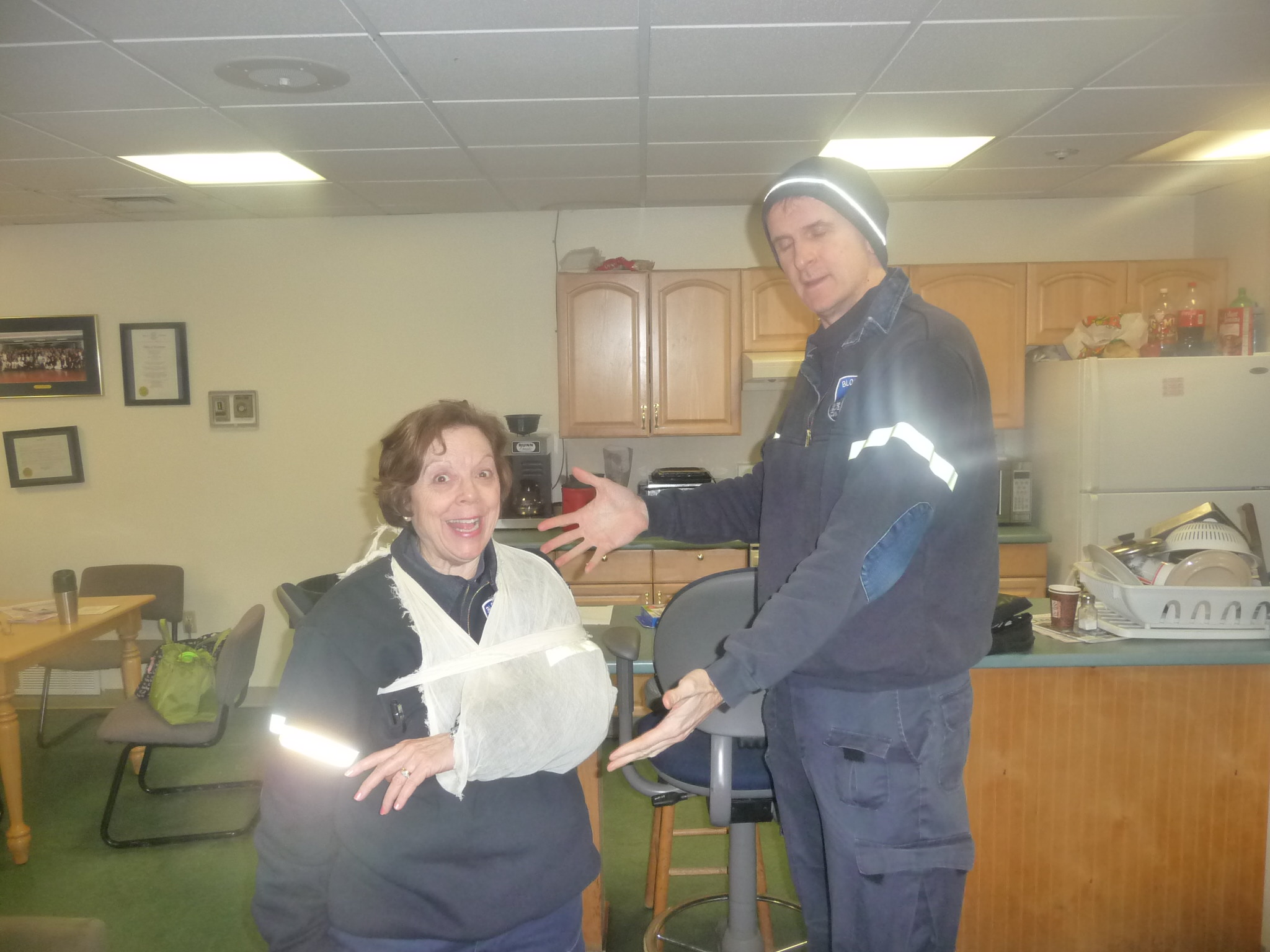
This stuff is awesome. My sling and swathing needed a tuneup and I have been grabbing every EMT that walks by and subjecting them to “”Hey, Do you mind if I sling and swath you?”

They think I am crazy. Maybe I am. My dream this morning is to become a Gran Leggo Master of Splinting, a Frank Lloyd Wright of the trade. When I bring a patient into the ED, not only do I want to have given them analgesia, I want to have splinted them with love and care and no spaces in the padding. I want to be able to say to the triage nurse: “Behold, my splint!”

Behold, my sling and swath!

The Bridge

5 comments

Part Two: A continuation from the previous post “Ice Road Paramedics”

So there I was (ala Commander McBragg) thirty feet about the frigid raging waters, having traversed an icy treacherous roadway on foot. My MediC Stat pack on my back, my hands out holding the sides of the narrow wooden foot bridge for balance, trying not to look down at certain death below (should the rickety boards below me give out). And ahead of me, the house on that rock island, the house surrounded by deep snow drifts, the house whose front door was being pummeled by an axe-swinging (again I exaggerate — crow bar banging) police officer, and somewhere inside slumped in a chair is what I believe to be a dead or dying man.

I think — if he is departed and beyond resucitation, let him be cold and stiff by a warm fire. Let there be no grey in the decision to work or not to work his body. And while I am praying, please don’t let me slip and fall — I am already halfway across — please I do not wish to plummet to my icy death or to land on the jagged rocks at the river’s edge. If the bridge is to give out, let it break first at the far side and go one board at a time like in the cartoons and let me run fast, one board ahead of disaster. Please no Wyle Coyote falls for me.

One by one we — my crew — make it across, and then step through the deep snow to the doorway, where the door, deadbolted has still not given way, despite the Paul Bunyonesque slams of the officer’s mighty crow bar (He was actually prying, banging in the appropriate manner). I ask the quiet and worried brother standing with us when he last saw his older brother, who he tells me is in his 80′s. He last saw him at sunrise, many hours ago now. He is dead, I am convinced of it, but I say nothing, just nodd.

The officer runs at the door now with his shoulder, and light from inside now shines through. Another ram and a kick and the door is open and we dash in. Through the foyer, and through the kitchen, down a hall, and through a dining room we go. Ahead I see the living room and hear the TV, now in sight — Let’s Make a Deal is on. I see the man now — his back is to me — slumped in his chair. I simultaneously see a grey pale face and a large hearing aide behind his left ear. The officer shouts as I reach for the man expecting another icy surface.

The dead man raises his head. “Oh, good day,” he says with a smile.

***

Not the first time that has happened.

***

A hour later after much time in the snow and ice helping free trapped vehicles and get them up the hill, and then making that long ice road journey back to our ambulance parked on the road, we are again in our warm quarters. I — in the recliner — hold the TV remote. Click, click, click and we are back to Die Hard which seems to always be on one channel or another.

Part One: Ice Road Paramedics

2 comments

Part One:

Picture this: One of those walk bridges over a canyon. You know the kind that sways when you walk on it, and has missing boards, and all you can hold on to is the fraying rope, and you are suspended 1000 feet up over rocks and a raging river. Well, it wasn’t quite like that, but if I tell the story enough that’s where it will end up.

Let me begin. Picture this. It is a nasty winter day. You are at work at your EMS job. You’re sitting back in your warm recliner, feet propped up, eating a hot meatball sub, watching Die Hard on the wide screen TV as the sleet clatters off the windows. One partner is snoring, the other is laughing manically as he texts on his Blackberry.

Got it.

Now picture this. A man arrives at the home he shares with his brother who he last saw this morning. The man does not have his key, so he knocks on the door, but no one comes, so he walks around the house through the deep snow peering in the windows. In the living room, he sees the TV on – Die Hard perhaps — and he sees his brother sitting in his chair. His head is slumped down. The brother knocks hard on the window, but his brother does not respond. He is dead motionless. The brother in the snow shouts and bangs again and again. No response. He takes out his cell phone and dials 911.

With me still? Nothing really unusual here. You could change the scenario to any potentially serious 911 call. A car off the road. A man down in the snow. A baby not breathing. And as for the responders, you could change that up to. Maybe instead of the big screen TV, it is a scratchy old set dug out of the trash with tin foil on the antenna. Maybe instead of Die Hard, it is American Pie. Pizza instead of a meatball grinder. Maybe the crew is sitting in an ambulance on a street corner watching the movie on a portable DVD or an I-phone. One partner – snoring or texting – instead of two.

Nothing unusual here. Either way — the tones go off, they call your number over the radio or your pager vibrates. One way or another, you get up – leaving John McClain to fend for himself – and soon your sirens are wailing and you are on your way to another run.

Now you have been lucky so far during this storm. All your calls have been at nursing homes or doctor’s offices and all the hospitals you have transported to have had covered awnings. You have barely gotten your boots wet. But you know this won’t last.

The address is in the mountains. You partner thinks he has been there before. Thinks it is a regular, but the address does not seem familiar. You know the road, but the street number doesn’t recall anything. The CMED dispatcher has no information for you. You wait to hear if the cops are out, but nothing comes over the radio. A part of you is expecting to hear them put out and a minute later (after they have kicked in the door) hear “CPR in progress,” but nothing.

When you get on the road, you see the cops patrolling looking for the number. One cop turns around realizing he has just passed it. “I guess I haven’t been here before,” your partner says. The driveway you discover is barely visible. It is likely a dirt road, but who can tell with all the snow. There is brush on either side of the road, barely passable for a police car. No way for the ambulance.

You get out and walk. No house in sight. The road is like an ice rink that hasn’t been cleaned by a Zamboni. It’s a good thing you are wearing your Fort Smith Boots in this sleet storm because the water and freezing slush and ice are treacherous. You walk carefully. The last thing you need is for you or your partner to go feet up in the air, head and butt slamming to the ground. Talk about a call from frozen over hell. Over the radio you hear one of the officers say he will come back and get you, but no car appears. You hear now his cruiser is stuck. Still no word from the other officer who is surely trying to gain access to the house that likely holds a cardiac arrest to test you and your crew’s mettle. You start to think about how once you get there — if you get there — you are going to get the patient out. You picture your crew doing CPR in the sleet all the way back to the ambulance here on this wild frozen trail in this first episode of a new reality TV show “Ice Road Paramedics.”

Finally at the end of a bend, the road drops down a hill where you see the two cruisers. There is a small turn-around but the road is sheer ice. You consider throwing your house bag down and using it as a sled to get down the hill, but you are worried that you will not be able to stop, only to shoot off the end of the land and into the raging rapids in the gorge below. That’s right — icy, churning rapids. The house which you now see is on the other side of the raging river (I am exaggerating slightly — it is more a raging mountain stream).

You make your way down through the snow on the side of the road. It is there that you first see the bridge — a ricketedy wooden foot bridge — thirty feet above that insane niagrous Artic megastream. You can’t believe what you have discovered. You think you know your town, but you have never been here before, never knew this place existed. The house is in fact on an island, completely surrounded by moving water.

And on the other side, a man inside a still locked house, slumped down in his chair. You can make out now the shape of a police man standing by the front door, raising a crow bar and smashing it against the door that will not open. Bang, Bang Bang!

And now you must make the crossing…

To be continued in Part Two: The Bridge

Memory

Comments Off

The man has dementia to the point he forgets that he called us. He forgets that he went to the hospital yesterday for the same complaint, forgets that they saw him and sent him home, forgets what they told him about it. “You were the one who called them,” his wife says, after he demands to know why we are in his bedroom.

He looks confused, but doesn’t deny that he might have called. It is as if he has some recollection of it, and is not certain enough to swear he didn’t.

“Is there anything wrong?” I ask.

“Me got pain here,” and he points below his belly button, same as yesterday. “Bothering me all night,” he says.

The house is disorderly. Yesterday I made the decision to put the man in a wheel chair and wheel him out to the breezeway where we had the stretcher set up. That way we didn’t have to move furniture and could maneuver well enough through the obstacles.

And so yesterday I wheeled him right to the door, leaving space to open it. I set the brake, opened the door and stepped into the breezeway. My plan was to help him step down, and then I could pivot him onto the stretcher. But before I could react, he felt the cold blast of air, and tried to kick the door shut. “COOOOLD!” he shouted. “YA trying to FREEEZE Me! Get out of Me House! Get out of Me House Now!”

And so ensued a struggle to keep him from locking us out while we braced the door against his kicks and negotiated to get back in the house and the whole time he was yelling at us like we were bandits come to rob him and then leave him out in the cold.

Today I say to my different partner, I want the stretcher brought into the bedroom. He looks at me like I am crazy. I acknowledge that we will have to move some furniture to get the stretcher in to the bedroom, but that is what we will need to do.

Memory.

The furniture moved, the patient wrapped tightly with thick blankets and our trademark towell around his head like a babushka, we carry out though the porch and then outside across the snow to our ambulance.

“Cold out,” he says rather calmly.